How Do Scientists Measure the Swimming Speed of a Humpback Whale Underwater?
Humpback whales are powerful swimmers that travel across oceans, explore breeding grounds, and dive beneath the surface in search of food or during other activities. Watching one move through the water can make its strength and agility easy to appreciate. But how do scientists determine how fast a humpback whale is actually swimming when much of its movement happens underwater?
Measuring whale swimming speed requires more than watching an animal disappear beneath the surface and reappear later. Researchers need information about how far the whale travels and how much time it takes to cover that distance. Depending on the study, they may use tracking tags, repeated position estimates, video measurements, or observations collected over a known distance.
Each method provides different information, and each has limitations. Understanding these techniques helps explain how marine scientists investigate whale movement without assuming that every whale swims at the same speed.
For people interested in Samaná whale watching in the Dominican Republic, this research offers a fascinating look at the science behind the movements seen during a whale-watching excursion.
What Does Swimming Speed Mean?
Swimming speed describes the distance an animal travels over a particular period.
The basic calculation is:
Speed = Distance travelled ÷ Time taken
For example, if a hypothetical whale travels 120 meters in 30 seconds, its average speed over that interval is 4 meters per second.
This example illustrates the calculation only; it is not a measured swimming speed for a humpback whale in Samaná.
Scientists distinguish between average speed and instantaneous speed. Average speed describes movement over an interval, while instantaneous speed refers to the animal’s speed at a particular moment.
A whale may accelerate, slow down, turn, or change its swimming direction during a dive. As a result, its speed at one moment may differ from its average speed over the entire observation period.
Researchers must decide which measurement best answers their scientific question before interpreting the results.
1. Using Electronic Tracking Tags
One method for studying whale movement is attaching a scientific tag to an animal. Depending on its design, a tag may record information such as acceleration, orientation, depth, or other movement-related measurements.
Some tags can help researchers estimate how the whale moves through the water. In certain studies, the collected data can be used to estimate changes in speed during diving, swimming, or other behaviors.
However, not every tracking tag measures speed directly. Some record motion or position-related information that must be processed to estimate movement.
The tag’s attachment method, recording frequency, sensor accuracy, and duration of deployment all influence the results. Researchers must also consider how the tag behaves on the animal and whether the collected measurements accurately represent the whale’s movement.
Tagging requires specialist expertise, appropriate permits, and careful attention to animal welfare. It is a research technique, not something necessary for ordinary whale-watching trips.
2. Calculating Speed From Repeated Position Measurements
Scientists can also estimate swimming speed by comparing a whale’s position at different times.
Suppose researchers obtain two reliable location estimates separated by a known time interval. They can calculate the distance between those positions and divide it by the elapsed time.
This gives an estimate of the whale’s average speed between the observations.
The method works best when researchers understand what the distance represents. The straight-line distance between two positions is not necessarily the full distance the whale swam.
For example, a whale might travel along a curved path between two locations. Measuring only the straight-line separation would underestimate the total distance covered.
Repeated measurements can provide a more detailed picture of movement, but the result depends on the frequency and accuracy of the position estimates.
If the observations are too far apart, short accelerations, turns, and changes in direction may remain undetected.
3. Measuring Movement With Underwater Video
Underwater video can provide another way to investigate swimming speed when researchers can observe a whale moving through a suitable field of view.
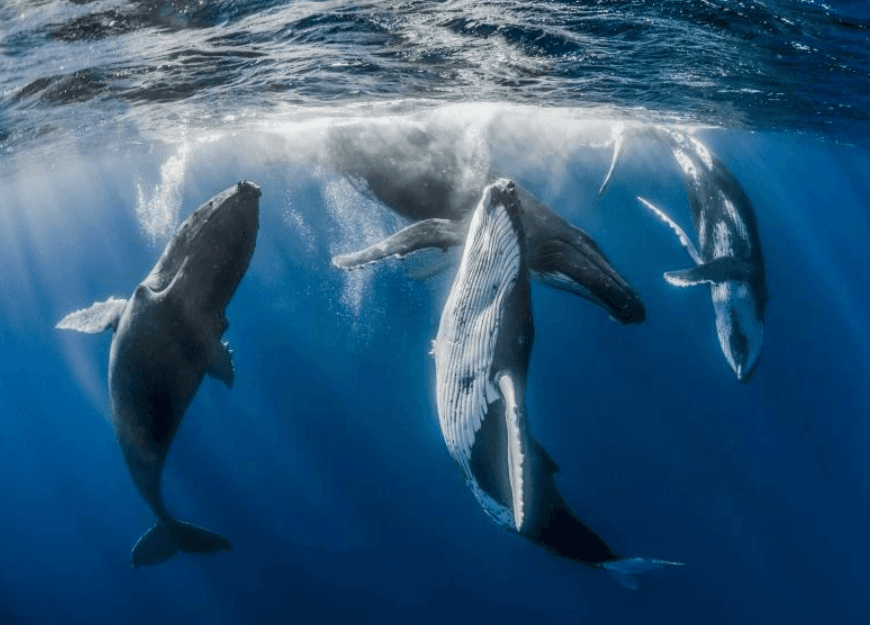
If the camera position and scale are known, researchers may track the whale’s movement across successive frames. The change in position over a known time interval can then be used to estimate speed.
For example, scientists might measure how far an animal moves between two video frames separated by a fraction of a second. Repeating the measurement can reveal changes in movement during the recording.
This approach has practical limitations. The camera may move, the whale may swim toward or away from the lens, and the apparent size of the animal can change with distance.
A two-dimensional image may also fail to capture the full three-dimensional movement of the whale. Accurate estimates therefore require appropriate calibration and careful analysis.
Underwater video can be especially useful for studying movement in a limited area, but it does not automatically provide a continuous record of a whale’s swimming speed throughout an entire dive.
4. Can Scientists Estimate Speed Using Acoustic Data?
Acoustic data can help researchers investigate whale movement when suitable recordings and localization methods are available.
Hydrophones record underwater sounds. With an appropriate arrangement of instruments, scientists may estimate where a vocalizing whale is located at different times. Those position estimates can then be used to investigate changes in location.
However, acoustic recordings do not directly measure swimming speed.
A whale may move without vocalizing, and a vocalization may be detected after traveling through the water along a complex sound path. Researchers must account for sound propagation, instrument positions, and uncertainty in the estimated source locations.
If a whale produces detectable sounds at multiple times and its position can be estimated reliably, those observations may contribute to a movement-speed calculation.
The result depends on whether the sounds can be associated with the same source and whether the time and position measurements are sufficiently accurate.
Acoustic tracking is therefore one possible source of movement information, rather than a universal method for measuring the speed of every underwater whale.
5. Why Swimming Speed Changes During a Dive
A whale’s swimming speed is not necessarily constant throughout a dive.
The animal may accelerate during one part of its movement, slow down during another, or change direction as it moves through the water. The purpose of the dive and the whale’s surrounding conditions may influence its behavior.
Scientists can investigate these changes by comparing movement measurements across different phases of a dive.
For example, a study might examine whether a whale’s speed changes between the beginning and end of a recorded dive. Researchers would need sufficient measurements to identify the pattern and determine how confidently it could be attributed to the animal’s behavior.
It is important not to assume that every humpback whale follows the same pattern. Different individuals and different situations can produce different movement records.
A single observation may describe what one whale did during one interval, but it cannot establish a universal swimming pattern for the entire species.
6. How Do Researchers Measure Acceleration and Deceleration?
Speed tells researchers how fast an animal is moving, while acceleration describes how quickly its velocity changes.
Velocity includes both speed and direction. A whale can therefore change its velocity by speeding up, slowing down, or turning, even if its speed remains similar.
Movement sensors can help researchers investigate these changes. For example, accelerometers measure changes in acceleration along particular axes. Other sensors may record orientation or depth, allowing scientists to interpret the movement in a broader context.
These measurements require careful processing. An accelerometer does not automatically provide a complete swimming-speed record, because its readings can include the effects of gravity, body rotation, and other movements.
Researchers may combine sensor data with other measurements to estimate how the animal moves.
This information can help describe movement patterns in greater detail than a single average-speed value, provided the method is appropriate for the question being investigated.
7. What Makes Whale Swimming-Speed Estimates Uncertain?
Several factors can affect the accuracy of a swimming-speed estimate.
Position accuracy: If researchers cannot determine the whale’s location precisely, the calculated distance may be uncertain.
Timing accuracy: Errors in the time interval can affect the calculated speed, particularly when measurements are taken over short periods.
Movement between observations: A whale may turn or change speed between two recorded positions, making the full path longer or more complicated than the available measurements suggest.
Instrument limitations: Tracking tags, cameras, and acoustic systems each have their own measurement constraints.
Environmental conditions: Water movement can matter when researchers distinguish the whale’s motion relative to the surrounding water from its movement relative to the seabed or another fixed reference.
That last distinction is important. A whale moving through a current may have a different speed relative to the water than its speed relative to the ocean floor. Researchers need to specify which type of speed they are reporting.
Good scientific studies describe their measurement method and acknowledge uncertainty rather than presenting every estimate as an exact value.
8. Is a Whale’s Swimming Speed the Same as Its Travel Speed?
Not necessarily. Swimming speed and overall travel speed can describe different aspects of movement.
Swimming speed usually refers to how fast the animal moves through the water. Travel speed over a journey may instead be calculated from the distance between locations and the total time elapsed.
If a whale repeatedly turns, changes direction, or pauses, its overall progress toward a destination can be slower than its swimming speed during active movement.
For example, an animal might cover a considerable distance while swimming but make relatively little net progress toward a particular location because its route includes turns.
This distinction matters when studying migration, local movement, or behavior around breeding grounds.
Researchers must define the quantity they measure before comparing results from different studies. Otherwise, two studies may appear to disagree even though they are measuring different types of movement.
9. What Could Swimming-Speed Research Tell Us About Humpback Whales in Samaná?
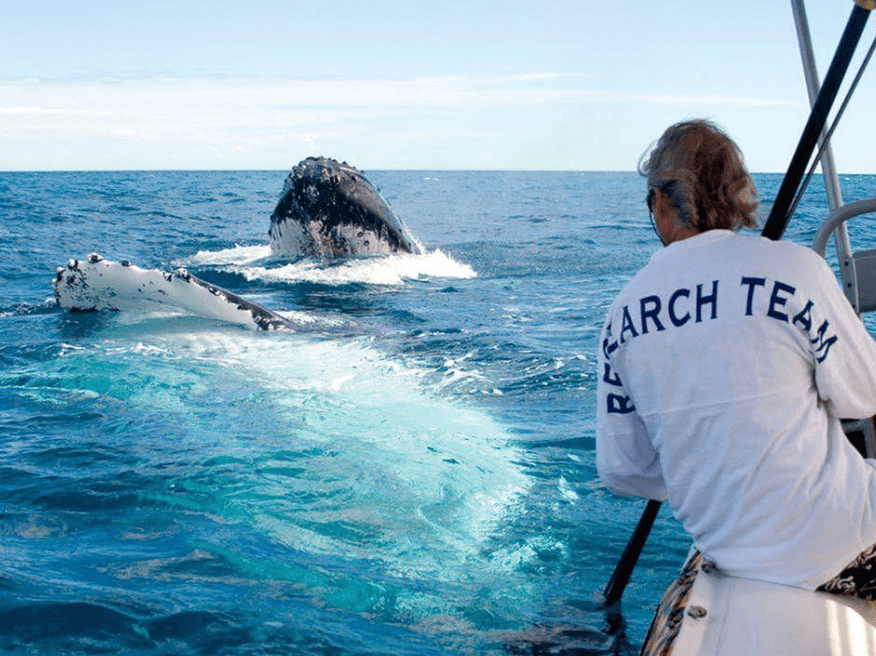
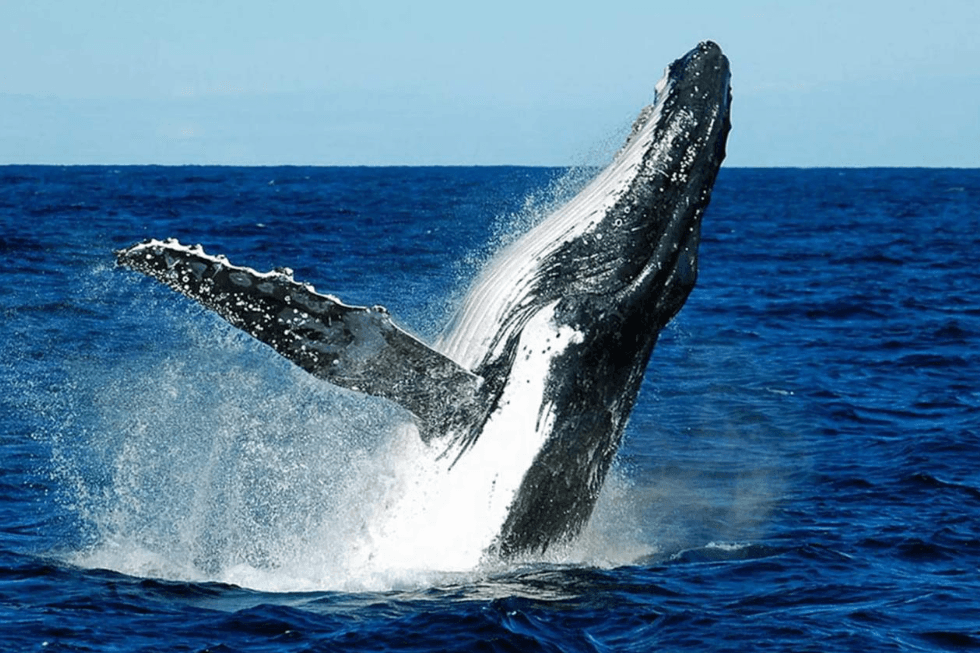
Samaná Bay is a well-known destination for observing humpback whales during the breeding season. Visitors may see whales moving near the surface, diving, surfacing to breathe, or raising their flukes before descending.
These visible behaviors provide opportunities to appreciate whale movement, but they do not establish an exact underwater swimming speed.
A dedicated scientific study in the region could investigate questions such as how measured swimming speed varies across observed behaviors, how movement changes during a dive, or how environmental conditions relate to recorded movement.
Researchers would need an appropriate study design and reliable measurements to answer those questions. The methods described in this article are general scientific approaches; they do not establish that a specific swimming-speed study has been conducted in Samaná Bay.
For visitors, the important lesson is that a whale’s visible movement represents only part of its activity. Scientific instruments allow researchers to investigate movements that cannot be measured accurately through casual observation alone.
10. What Can Whale Watchers Learn From These Measurements?
You do not need a tracking device or a scientific calculation to appreciate a humpback whale’s swimming behavior.
During a whale-watching excursion, you may notice the direction in which a whale travels, the sequence of a dive, or the way its body moves as it surfaces. These observations can make the encounter more engaging.
However, estimating speed from a boat can be difficult. The vessel may be moving, the whale may change direction, and its underwater route may be unknown. A brief visual observation should not be treated as a precise scientific measurement.
Listening to an experienced guide can help you understand the behavior you are observing while recognizing the limits of what is visible.
Responsible whale watching also means respecting the animal’s space and allowing it to move naturally. Visitors should follow the crew’s instructions and applicable wildlife-viewing regulations rather than attempting to approach a whale to measure its movement.
Conclusion: How Scientists Measure Humpback Whale Swimming Speed
Scientists estimate humpback whale swimming speed using measurements of distance and time, supported by tools such as tracking tags, underwater video, and repeated position estimates.
Each method provides different kinds of evidence. Electronic tags can record movement-related data, calibrated video can measure motion within a visible area, and acoustic localization may help estimate changes in the position of a vocalizing whale.
The accuracy of the final result depends on the measurement method, the quality of the observations, and how researchers account for changes in direction, currents, and uncertainty.
For anyone interested in Samaná whale watching, understanding this science adds another layer of appreciation to the encounter. A whale moving through the water is not simply a spectacular sight; its movement can also reveal valuable information about its behavior when scientists have the tools and evidence needed to measure it.
Planning a trip to see humpback whales in Samaná? Learn about the seasonal viewing period, choose a responsible whale-watching operator, and follow local wildlife-viewing guidance. Enjoy observing these remarkable animals while leaving them free to move through their natural habitat.

Local explorer & expert guide in Samaná Whale Sanctuary.