How Do Scientists Estimate the Distance to a Singing Humpback Whale Underwater?
When a humpback whale produces a song underwater, the sound can travel through the surrounding ocean before reaching a recording device. Scientists can capture these vocalizations using underwater microphones called hydrophones, but an important question remains: how far away was the whale when it produced the sound?
Estimating the distance to a singing humpback whale is more complicated than measuring how loud a recording sounds. Sound changes as it travels through water, and its recorded strength depends on several factors, including the whale's original sound level, the environment, the recording equipment, and interference from other sounds.
Researchers therefore use different acoustic methods to investigate the location of vocalizing whales. Depending on the equipment and available information, they may estimate distance from sound levels, compare arrival times at multiple hydrophones, or combine acoustic measurements with other observations.
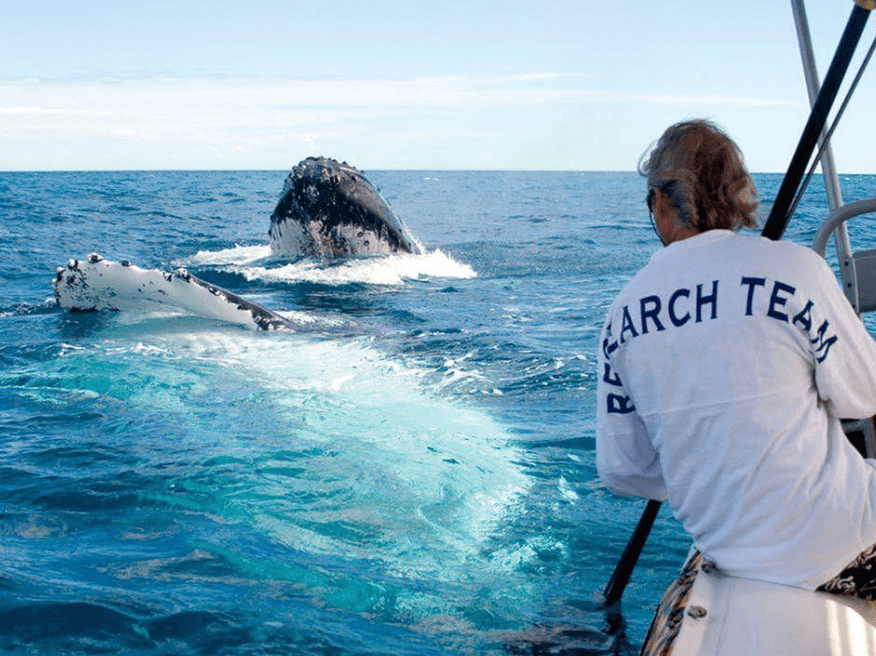
Understanding these methods helps explain how scientists study whales that cannot always be seen from the surface. It also adds another dimension to Samaná whale watching in the Dominican Republic, where observing a whale and locating an underwater sound source are two different scientific challenges.
Why Is It Difficult to Estimate the Distance to a Singing Whale?
Underwater sound does not travel through a perfectly uniform environment. Its path and strength can be affected by water depth, temperature, salinity, the seabed, and the surrounding acoustic conditions.
A hydrophone records the sound that reaches its location, not the original sound exactly as the whale produced it.
For example, a relatively strong recording could come from a nearby whale producing a moderate sound or a more distant whale producing a stronger sound. Without additional information, those possibilities may be difficult to distinguish.
Other factors complicate the estimate:
- Background noise may obscure the whale's vocalization.
- The whale may move while singing.
- The sound may travel along different paths through the water.
- The hydrophone's sensitivity and orientation can affect the recording.
- The whale's original sound level may not be known.
- Other whales may vocalize at the same time.
These factors mean that researchers need to distinguish between detecting a vocalization and estimating the location of its source. Hearing a whale song confirms that sound reached the recording system, but it does not automatically reveal how far the whale was from the hydrophone.
1. Using Sound Levels to Estimate Distance
One possible approach is to measure the received sound level and investigate how it changes as sound travels away from its source.
In a simplified situation, sound from a point source spreads outward as it travels. The acoustic energy becomes distributed over a larger area, causing the received level to decrease with distance.
In an idealized free field, this spreading is often described using spherical spreading loss. Under those assumptions, the sound pressure level decreases by approximately 6 decibels for every doubling of distance.
However, the ocean is not always an ideal free field. Sound may interact with the surface and seabed, travel through different water layers, or experience frequency-dependent absorption.
To estimate distance from sound level, scientists need more than the level recorded by the hydrophone. They also need information about the original source level or a suitable estimate of it, along with an appropriate model of how sound propagates through the environment.
Without these additional inputs, the recorded level alone cannot provide a reliable distance measurement.
This method can be useful when the necessary assumptions and supporting information are available, but researchers must account for uncertainty in the source level and the acoustic environment.
2. Understanding Sound Propagation Underwater
Sound propagation describes how sound travels from its source through the surrounding water.
In the ocean, sound speed varies with temperature, salinity, and pressure. These variations can bend sound paths and influence where acoustic energy travels.
The seabed and sea surface can also reflect sound. Depending on the environment, a hydrophone may receive a signal that has traveled along multiple paths rather than one simple route.
These effects are important because the distance traveled by the sound is not always the same as the straight-line distance between the whale and the recording equipment.
Scientists can use acoustic propagation models to investigate how sound may travel through a particular environment. Such models may incorporate water depth, sound-speed profiles, seabed characteristics, and the frequency range of the sound.
Researchers can then compare the expected propagation patterns with their recorded measurements.
A model does not eliminate uncertainty, especially when environmental information is incomplete. Instead, it provides a framework for understanding how the underwater environment may influence the recording.
For studies in coastal locations such as Samaná Bay, the suitability of a propagation model would depend on the local conditions and the information available for the research area.
3. Using Multiple Hydrophones to Locate a Singing Whale
A single hydrophone records sound at one location. An array of hydrophones provides recordings from multiple locations, which can offer more information about the position of a sound source.
If the same whale vocalization reaches several hydrophones, researchers can compare the signals recorded at each sensor.
The sound may arrive at one hydrophone slightly earlier than at another because the distances from the source differ. These small timing differences can help scientists estimate the direction or position from which the sound originated.
With a suitable array design and enough reliable measurements, researchers may be able to estimate the source location in three dimensions.
The result depends on the geometry of the array, the accuracy of the timing system, the quality of the recordings, and the acoustic environment.
A poorly positioned array may provide insufficient information to distinguish between possible source locations. Likewise, overlapping whale songs or substantial background noise can make it difficult to match the same vocalization across recordings.
Multiple hydrophones therefore do not guarantee an exact answer, but they can provide information that a single recording cannot supply.
4. Measuring Differences in Sound Arrival Time
One method used with multiple hydrophones is called time-difference-of-arrival analysis.
The basic principle is straightforward: a sound reaches sensors at different times when those sensors are at different distances from its source.
Scientists identify a matching acoustic event in two or more recordings and measure the time difference between its arrival at the sensors.
Because the speed of sound in water is known approximately—and can be modeled more precisely when environmental information is available—these time differences constrain the possible location of the source.
For example, suppose a recognizable sound reaches one hydrophone before it reaches another. The timing difference can help establish which regions of space are consistent with the observations.
With only two sensors, the possible source locations may remain ambiguous. Additional sensors and suitable geometric arrangements can help narrow the possibilities.
Researchers must also account for synchronization errors, reflections, and uncertainty in identifying the same sound across multiple recordings.
This method is particularly valuable because it uses the timing of the sound rather than relying entirely on how loud it appears.
5. Using Directional Information From Hydrophone Arrays
Some hydrophone arrays are designed to estimate the direction from which sound arrives.
By comparing signals across multiple sensors, researchers can examine differences in arrival time and phase. These measurements can provide directional information about an underwater sound source.
One approach, known as beamforming, combines signals from an array in a way that emphasizes sounds arriving from selected directions.
Researchers can examine which directions produce the strongest or most consistent acoustic signal and use this information to investigate where a vocalization originated.
However, directional information is not always equivalent to a complete distance estimate.
A system may indicate that a sound is coming from a particular direction without revealing how far away the source is. Additional measurements, multiple arrays, or other localization methods may be needed to estimate range.
The performance of these methods depends on sensor spacing, array configuration, frequency, background noise, and the properties of the underwater environment.
Scientists select the approach that best matches their equipment and research objectives.
6. Estimating Distance From Signal Travel Time
In some situations, researchers can use the travel time of a sound to estimate distance.
The underlying relationship is simple:
Distance equals sound speed multiplied by travel time.
However, the method requires a known or identifiable starting time for the sound and a reliable measurement of the time it takes to reach the receiver.
For a naturally produced whale song, the exact moment of sound production is usually unknown unless additional information is available. A hydrophone records the arrival of the sound, not necessarily the time when the whale produced it.
Consequently, scientists generally cannot estimate the whale's distance from a single naturally occurring vocalization merely by measuring how long it took the sound to reach the hydrophone.
Time-based localization usually relies on additional information, such as arrival-time differences across synchronized sensors or a known acoustic event.
This distinction is important because sound-travel-time calculations are only useful when the relevant timing information is available.
7. Combining Acoustic Measurements With Visual Observations
Researchers may sometimes have visual observations that help them interpret acoustic recordings.
For example, if a whale is observed near the surface while a recording system captures a vocalization, the visual information may provide a potential clue about the source's location.
But the presence of a whale near the recording equipment does not automatically establish that it produced the sound. Other whales may be present, and underwater sound can travel beyond the area visible to observers.
Scientists must therefore establish a reliable connection between the acoustic event and the observed animal before using the sighting as direct evidence of the sound source's position.
Suitable supporting information might include synchronized video, documented observation times, carefully designed acoustic monitoring, or other evidence that links the source to the recording.
Visual observations can complement acoustic measurements, but the strength of the conclusion depends on the quality of the combined evidence.
8. Tracking a Whale That Moves While Singing
A whale does not necessarily remain in one place while producing a song. It may change position or depth, making distance estimates more challenging.
If researchers treat all recordings as though the source remained stationary, the resulting estimates may not accurately describe the whale's movement.
To investigate a moving source, scientists can analyze successive vocalizations and estimate their locations over time. Repeated measurements may help reveal a likely movement path, provided that the data are sufficiently accurate and the sounds can be associated with the same source.
Some studies may combine acoustic localization with other tracking information, such as observations from suitable tags or visual monitoring.
However, repeated recordings do not automatically prove that every sound came from the same whale. Researchers need a reliable basis for associating the signals before constructing a track.
When the evidence is incomplete, it may be more appropriate to describe a series of possible source locations than to claim an exact path.
This approach recognizes that animal movement and acoustic uncertainty are both part of the research problem.
9. How Background Noise Affects Distance Estimates
Underwater background noise can make it difficult to detect a whale song and measure its acoustic features accurately.
Vessel noise, other animal vocalizations, water movement, and recording-system noise can all affect the quality of the signal.
If noise masks part of a whale vocalization, researchers may struggle to identify its arrival time or compare it with recordings from other sensors. This can reduce the accuracy of localization.
Noise may also affect sound-level measurements. A received level that includes substantial background noise does not represent the whale's signal alone.
Researchers can use filtering, signal processing, careful sensor placement, and other appropriate techniques to improve analysis. However, processing cannot always recover information that was never recorded clearly.
Scientists must also avoid assuming that a sound that is not detected is absent. The whale may be too distant, its vocalization may be too weak, or background noise may prevent detection.
For this reason, acoustic detection and distance estimation are best interpreted alongside information about recording quality and the limitations of the equipment.
10. How Accurate Are Underwater Distance Estimates?
The accuracy of an estimate depends on the method, the recording system, and the environmental conditions.
A well-designed synchronized hydrophone array may provide useful localization information, while a single recording with an unknown source level may offer only limited clues about distance.
Researchers evaluate uncertainty by examining factors such as:
- The precision of sensor positions and timing.
- The reliability of sound detection.
- The number and arrangement of hydrophones.
- The sound-speed conditions in the water.
- The influence of reflections and background noise.
- Whether the source moves during the observation.
- The assumptions used by the localization method.
Instead of reporting an unsupported exact distance, scientists may provide an estimated location, a range of plausible distances, or a measure of uncertainty.
A good scientific result makes clear what the data can support and what remains uncertain.
This is especially important when interpreting recordings made in complex coastal environments, where sound propagation may be influenced by depth, the seabed, and nearby vessel activity.
What Could Distance Estimation Research Mean for Samaná Bay?
Samaná Bay in the Dominican Republic is widely known as a seasonal destination for observing humpback whales. It also provides a useful context for discussing how researchers might investigate the location of underwater vocalizations.
A study using appropriate acoustic equipment could examine questions such as:
- How reliably can vocalizing whales be localized under different recording conditions?
- How does hydrophone placement affect the accuracy of distance estimates?
- How does vessel noise influence acoustic localization?
- Can repeated acoustic observations help researchers estimate the movement of a vocalizing whale?
- Which environmental measurements are needed to model sound propagation in the area?
These are potential research questions, not claims that a specific whale-localization project has already been conducted in Samaná Bay.
Answering them would require appropriate equipment, documented acoustic data, a suitable study design, and careful evaluation of uncertainty.
For whale-watching visitors, the science illustrates an important distinction: seeing a whale at the surface and locating a singing whale underwater are different tasks. Acoustic researchers must use specialized methods to investigate sources that may be hidden beneath the water or beyond visual range.
Can Visitors Estimate a Singing Whale's Distance During a Whale-Watching Trip?
Ordinary whale-watching visitors generally cannot determine the underwater distance to a singing whale simply by looking at the sea or listening from a boat.
Songs travel underwater, and their apparent loudness is influenced by multiple factors. A sound that seems strong may not come from the nearest whale, and a faint recording does not necessarily mean that the source is extremely far away.
Reliable distance estimation requires suitable measurements and a method that accounts for the relevant acoustic conditions.
Visitors can still appreciate the research by learning how hydrophones work and why scientists use multiple sensors to locate sound sources. These concepts show how researchers can investigate animal behavior that is not directly visible.
During a whale-watching excursion, visitors should follow the guide's instructions and respect applicable wildlife-viewing rules. The priority is observing marine mammals responsibly rather than attempting to approach a whale based on an assumed acoustic location.
Final Thoughts
Estimating the distance to a singing humpback whale underwater requires more than measuring how loud its song sounds. Scientists may use sound-level analysis, propagation models, multiple hydrophones, arrival-time differences, directional methods, and supporting observations to investigate the source's location.
Each method has strengths and limitations. A single hydrophone may detect a song without revealing its distance, while a suitable array can provide additional information about direction and position. Moving whales, background noise, and changing underwater conditions can all introduce uncertainty.
The most reliable studies explain how the estimates were produced and how confident researchers can be in their results.
For anyone interested in Samaná whale watching, this research highlights another remarkable aspect of humpback whales: even when an animal is hidden beneath the ocean surface, carefully collected acoustic evidence can help scientists investigate where it is and how it moves.

Local explorer & expert guide in Samaná Whale Sanctuary.